Showing posts with label High Holidays. Show all posts

Wednesday, October 10, 2012

The Spirit of Succoth: Ushpizin and Farming


JDC's Succoth Events


In an attempt to complement, and not compete with or divide the community, we decided to hold two Succoth events as the first two JDC events of this year. These events were designed to bridge gaps and provide opportunities that otherwise would not exist in the Jewish community. This year, Succoth and the Chinese October holiday fell at the same time, giving us the opportunity to do something doubly meaningful. Succoth and the Mid-Autumn Festival have a few things in common, and it allowed us to organize content-filled and meaningful activities.

The first of these events was a Succah-Crawl, following the long and beautiful tradition of ushpizin during Succoth. In what turned out to be a revolutionary, first-ever occasion, I set up an afternoon of visiting five different succot across the city and across the wide spectrum of the community. We were a group of about ten Jews, ranging in age from mid-twenties to mid-fifties (though a few young children joined for parts of the event). The first two of these were private succot, in the homes of liberal, mixed-marriage families in the French Concession. We spent about 45 minutes in each one, eating snacks (including halva cookies I made for the event) and chatting. We walked from one to the other, which gave a neighborhood feeling to the occasion, a rare experience in huge, bustling Shanghai. We had to cancel the Downtown Chabad center, as they just had a baby.

We then took taxis to the Hogqiao area, where we visited the Sepharadic Center and then went to their succah. Many members of the group had never been in to this center, and it was a pleasant experience. We sat with the rabbi and his wife and daughter, had home-made pastries and learned about the four species and the meaning of Succoth. We then walked to the Shanghai Jewish Center (Chabad) for the big finale: a sushi dinner. The rabbi and I had coordinated the event so that it would coincide with his sushi night. It was a nice ending, having sushi dinner all together in the big community succah.
The trip to the Farm is something that came together thanks to Rebecca Kanthor. In the days leading up to it, it became extremely popular among families, and in the end we had 45 people, including 18 children (15 of whom were under the age of 6), and about 7 single young professionals. This organic farm was on Chongming Island, about an hour and a half from Shanghai, though with the holiday traffic that time was doubled. Their primary products are wheat and bean, and so they sell all kinds of flour, soy sauce, bean paste and black sesame, among other things.
Upon arrival, we made vegetarian dumplings and pita, and had a delicious organic and local vegetarian lunch, complemented by hummus and pesto. Then we took a walk of the farm and around the village, and picked some beans. The kids got to run around in nature and chalk the sidewalk with fat neon-colored chalk I had brought along. The adults got to chat and eat some healthy, delicious food. Then we walked around country roads rimmed with wild cotton plants, wearing big straw hats.

But these truly are stories best told in pictures.
 

Succah-Crawl in Shanghai
Our First Stop: Ben and RC's Succah
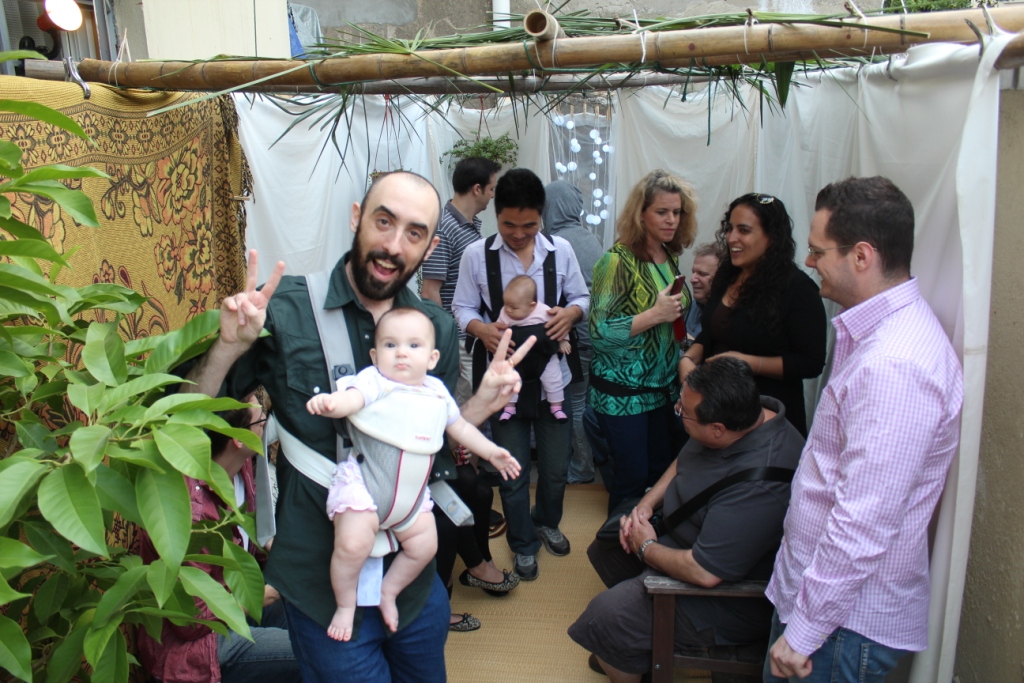


Our Second Stop: Rebecca Kanthor and Liu Jian's succah


Our group in Rebecca's succah
 
The Trip to the Farm
Making Dumplings
 
 
The Final Product
 
 
Having Lunch
 
 
Chalking 


A Walk around the Farm


In the Forest


Picking Beans


Monday, September 24, 2012

Being Internationally Spiritual


There is nothing quite like having to explain the concept of atonement to a bunch of older kids (or young teenagers, depending how you look at it) to make you really think about it. In Hebrew School class yesterday, talking about Yom Kippur, we defined atonement as repentance, leading to asking for forgiveness.  (Atonement as the main translation for the word kapara).

We talked about why it comes right after the New Year, and what a wonderful spiritual opportunity it is to do some soul-searching and accounting before a new year begins. We explained that in our tradition we talk about our relationship with G-d, with other people, and with ourselves, and how we understand that it is important to work on all of these relationships. I, liberal person that I am, emphasized the individual nature of this, and the fact that they all (but especially one's relationship with G-d) can mean something different for all of us.

My co-teacher is religious, and it's interesting to observe how differently we approach talking about things, especially anything related to faith. She sort of goes right ahead and says "the party line", whereas I'm a lot more hesitant, pluralistic and, well, secular. It may be because I understand who these children are and where they come from a little bit better, and I know that talking too much about religion will not go over well with certain parents. But really I think that she is much more comfortable talking about faith and G-d and stuff and for me it's hard. We don't really do that in the secular bubbles I consider myself a part of.

 We then had the kids write down (as practice for the Shorashim project they're all going to do this year) their resolutions or atonements, giving them an opportunity (which I later realized probably no one has given them before) to actually engage in this practice of thinking about how they want to start their new year. About half the group has had their bar/bat mitzvah, so in many ways I'm supposed to prepare them for Jewish adulthood, too.

I have to honestly admit that the depth of this exercise eluded me when I first thought of it. My original goal had been to get them writing something personal, something to get their juices flowing in thinking about themselves. I realized the impact of it when they all sat, in rapture, listening to me explain something I, in all honesty, understand very little about.

But if there's one thing I've learned teaching Hebrew School across the world (aside from the fact that it's so wonderful to be in a position to get kids to want to come when they initially really don't): you gotta plough through sometimes, and in an elegant way explain that neither you nor anyone else has all the answers. You gotta explain these massive questions of the human existence (thank G-d I've had Hannah Arendt to prepare me for this) in a way that is relatable, real, and accessible. Humility, at this point, is the best tool at your disposal. Humility, and the ability to make things fun.

I left class thinking I should probably do some soul-searching myself this season.

Recently I've been dealing with how professional my Jewish practice has become. I have to go to services, to the various communities, because people will ask me where I've been (and why I wasn’t with them). I usually take a few people with me to different services, as there's always someone new and it's nice to be able to help out – one of the benefits of staying somewhere longer than a year.

There's also an element of fragmentation to my High Holidays experience. This is my second year in Shanghai. Before here I was in India for two years (one year with the very traditional, very unique community, one year  traveling up and down Western India for the holidays with Ronan, going to Chabad Houses but also doing some local stuff), before that I was in New York (modern orthodox, gay-friendly, synagogue in the UWS, Ashkenazi, obviously), before that in Paris (Moroccan-Orthodox), and before that, in Middlebury (Reconstructionist, Ashkenazi, ultra-Liberal). I don't remember what my family does or what "I'm used to", and in any case it's probably changed at least three times since I last spent the HH with them, which was in Madrid in 2004 (Orthodox Ashkenazi in the basement of the synagogue, with some strong Sepharadic undertones). Throw in the fact that I've been working in the Jewish world for three years and it's no wonder (though admittedly quite ironic) that I feel a little disconnected.

Tradition and continuity, and doing the same thing year in and year out, are important. I understand that, now perhaps more than ever. And part of what I'm trying to figure out is what kind of religious practice – and what kind of community – fits this very international lifestyle. The great thing about Shanghai - and other communities in the region – is that there are many people like me, so the culture of the community is very international and diverse. People connect quickly, they're nice and welcoming to newcomers and the institutions and their leaders (mainly Chabad and the wonderful rabbis and rebetzins that are here) are set-up to accommodate transience and international diversity.

Perhaps my problem, then, is that I have not yet found a way to have a coherent, consistent and personal spiritual experience that transcends on one hand place, tradition and custom, and on the other, the issue of working in the field with a community made up of people who are exactly like me. This boundary between the personal and the professional (which I think is always an issue when you're working in the field and have human needs like making friends and other meaningful connections) when put in the spiritual context takes on a more complicated dimension. It requires, for example, not necessarily socializing when going to the synagogue, or not going "for prayers" – as the Indians say – at all (I think I am realizing that this is a personal preference for YK day, for example). While I probably can't do that this year – I almost had a meeting scheduled for that day, and definitely have to go to at least one, if not two, services – being honest about my spiritual crisis is helping me do something about it.